Training Hub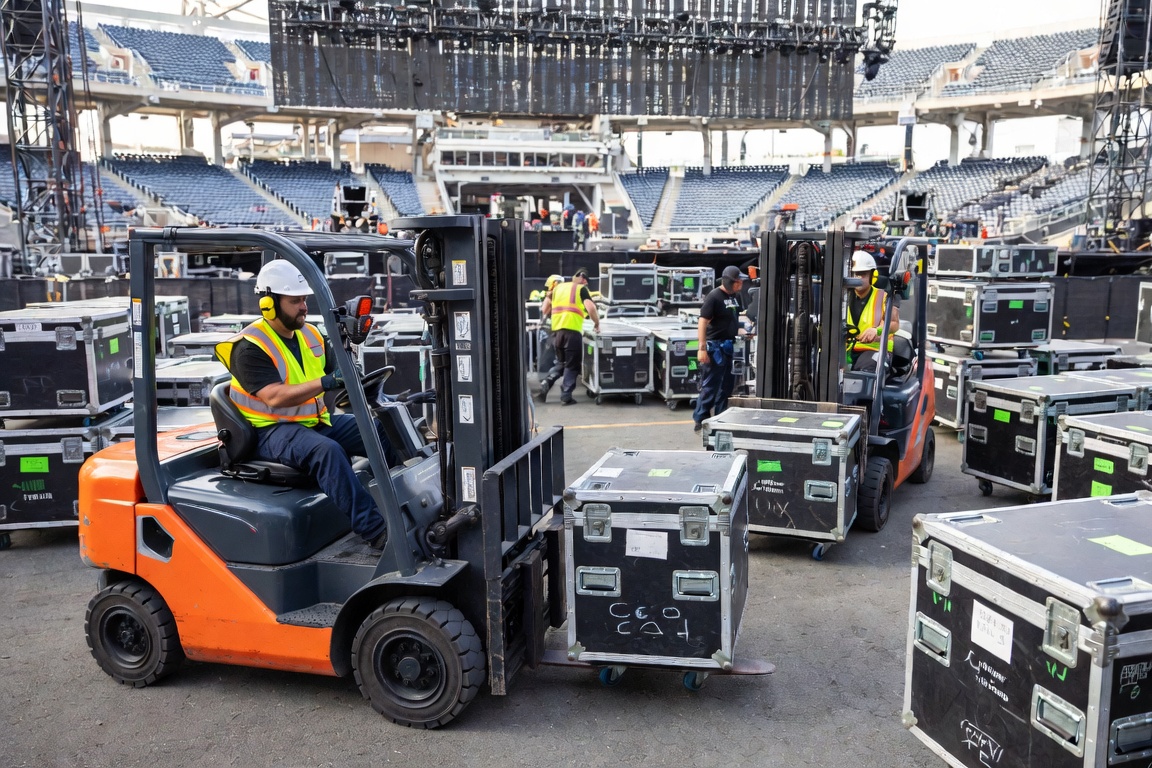
Module 1Not Started
Legal Baselines & Certification
The federal floor every touring operator stands on
8 min read 11 scenarios · 80% to pass
Why this matters
A warehouse card is not a tour license. Operating a class of machine you aren't certified on — or skipping the workplace evaluation — voids insurance and drops the whole tour's liability onto you personally.
Module briefing
01
The Legal Reality — Who Certifies You
Here is how the legal reality breaks down according to OSHA standard 29 CFR 1910.178:
OSHA sets the rules, they don't teach the class: OSHA writes the safety standards and regulations that must be followed. OSHA does not approve, accredit, or certify any training course — including this one.
The legal burden sits with the employer: the employer (the concert labor company, production house, or venue) is the party that must certify you have been trained and evaluated, and is accountable if you haven't been.
But the employer does not have to do the teaching. OSHA has stated that the people who conduct training, refresher training, evaluation, and certification need not be employed by your employer — a union, a training organization, or a joint labor-management program can deliver it. What the employer cannot delegate is responsibility for making sure it actually happened, on your machine, in your workplace.
Hard Rule· The official paperwork
The certification record must list the operator's name, the date of the training, the date of the evaluation, and the identity of the person(s) who performed the training or evaluation. The standard requires their identity — not necessarily a signature — but a named, reachable evaluator is what makes the record hold up.
02
The OSHA 29 CFR 1910.178 Three-Part Mandate
Certification is not one class you sit once. It is three distinct pillars.
- Formal instruction — classroom or online: truck physics, center of gravity, load stability
- Practical training — hands-on maneuvers on the actual type of machine
- Employer evaluation — a formal performance assessment in the actual workplace
- Re-evaluation at least every 3 years, and after any incident, near-miss, or new equipment
Hard Rule· No evaluation, no operation
Missing any one of the three pillars makes the certification invalid — no matter how experienced the operator is.
03
The PIT Classification Trap
A certification is per-class, never universal.
Powered Industrial Truck (PIT) classes: Class 1 electric sit-down counterbalance and Class 4/5 internal-combustion counterbalance (cushion or pneumatic tire) move road cases, cable trunks, and rigging steel inside arenas and convention centers.
Class 7 rough-terrain forklift / telehandler — the 'shooting boom' (Skytrak, JLG, CAT) — builds outdoor stages, moves generators, and works muddy, uncompacted terrain.
A Class 1/4/5 warehouse card does NOT legally authorize a Class 7 telehandler. They are separate machines with separate certifications.
Hard Rule· Separate cert per class
Every distinct machine class needs its own documented certification and its own hands-on evaluation. On tour, cross-training is mandatory — never assumed.
04
MEWP Certification (ANSI A92)
Touring operators routinely run aerial machines alongside forklifts. Under the ANSI A92 standard, operators must hold MEWP (Mobile Elevating Work Platform) certification for the machines they use.
Boom lifts are Type 3, Group B; scissor lifts are Type 3, Group A. They are used in tandem with forklifts to fly lighting trusses and audio arrays into position — and they are entirely separate credentials from any PIT class.
Core Drill· Core Drill — match the card to the machine
Before you touch a boom or scissor lift, confirm you hold a current MEWP A92 certification for that type. A forklift card covers neither.
05
The Credentials Tour Companies Require
Beyond the federal minimum, major production companies (Live Nation, AEG) and union venues expect more: an OSHA 10 card for touring crew, OSHA 30 for production managers and site heads.
The Event Safety Alliance (ESA) Event Access Safety Training (EAST) is designed for the chaotic backstage load-in. Basic rigging awareness — load capacities and hoist mechanics — is highly valued even if you're not the head rigger.
Tour Reality· Cards live in your pocket
On tour you physically present these credentials at each venue. Keep current copies on you — an expired card at the dock is the same as no card.
Deliberate Practice
Interactive Scenario Trainer
Begin Interactive Scenarios
11 real situations from the floor. Type your decision — the trainer grades it against the named technique and gives you instructor-level feedback. Pass mark: 80%.