Training Hub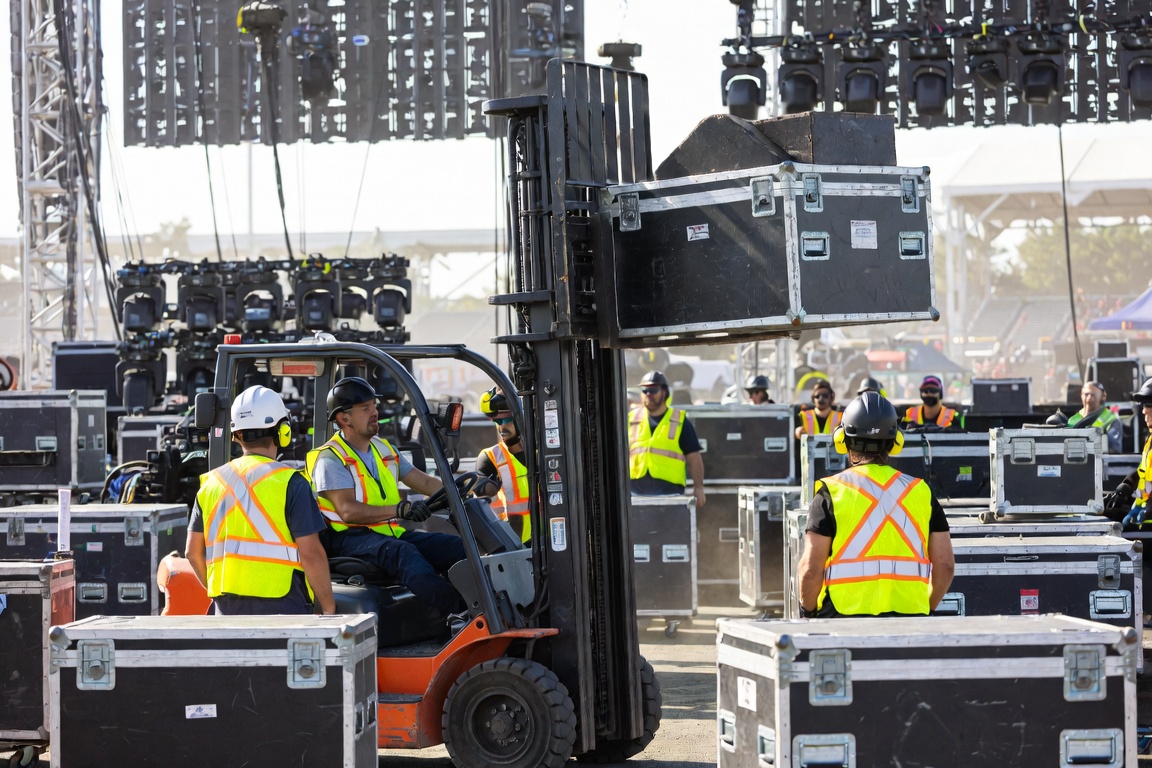
Module 7Not Started
The Staging-Line Load-Out
The stationary forklift as a high-speed hoisting station
8 min read 11 scenarios · 80% to pass
Why this matters
In an efficient load-out the forklift stops being a delivery runner and becomes a fixed hoisting station — the crew brings the work to the machine. A shared shorthand keeps the load-out fast AND keeps hands out from under the tines.
Module briefing
01
The Logistics Crew & Chain of Custody
Treat the loading dock as a stationary assembly line with a strict chain of custody.
The flow: pre-staged lines of cases → the Caller → the Pushers → the stationary forklift → the four truck loaders. Each role has one job and one lane.
Pre-staged lines: stagehands organize cases into single-file lines on the venue floor before the doors open. The golden rule is one line equals one specific truck — cross-contaminating lines breaks the system. Because cases are lined up ahead of time, the operator never hunts blind corners for gear.
The Caller stands to the side with the master pack list and calls the exact case/cart numbers and where they fit the truck's packing grid (e.g., 'A-row, bottom'). The Pushers pull those cases and wheel them to the tip of the tines. The forklift stays localized at the truck tail as a hoisting station. The four truck loaders work in pairs inside the trailer — two positioning, two strapping the next row on E-track.
Tour Reality· The machine holds still; the work comes to it
The forklift localized at the truck tail — not running the floor — is what makes a load-out tight, fast, and safe. The crew feeds the machine.
02
Hot Dog vs. Hamburger — Fork Orientation
A one-word shorthand the Caller, Pushers, and Operator all speak instantly.
HOT DOG (lengthwise): the case runs parallel to the forks — long and narrow like a hot dog in a bun. Used for narrow clearances (tight hallways, standard doors, skinny ramps) and deep 'straight-in' truck packing. Operator risk: the load extends far out front, shifting the load center forward — this reduces lifting capacity and makes the rear wheels prone to lifting under a heavy brain or audio rack.
HAMBURGER (straight on / wide): the case sits sideways with its short side to the mast — short and wide like a hamburger. Used for maximum stability with heavy or top-heavy cases (a rack of power amps) and for packing two- or three-wide across a 53-foot trailer. Operator risk: the load is wide — stay hyper-aware of clearances so you don't clip door frames, walls, or the Caller at the staging line.
Core Drill· Core Drill — the Caller calls the orientation
The Caller yells the method with the number — 'Case 104, Hamburger!' Pushers pre-spin the case to that orientation; the operator sets tine width to match. On a Hot Dog, narrow the tines so they don't protrude past a skinny case and spear an adjacent cart.
03
The Stationary Hand-Off
The physical hand-off is the danger zone — drill it until the sequence is reflex.
The three golden rules of the hand-off, drilled until reflex: (1) the Tine Buffer Zone — pushers never touch a case while you are actively scooping or lifting it; they drop the cart at the tines and step away. (2) No hands on hydraulics during the physical hand-off. (3) The Stop Trigger — if anyone steps into your turning radius before you're parked with the brake set, all vehicle movement stops immediately.
- Approach the truck tail and come to a COMPLETE stop
- Set the parking brake
- Lower the load to a manageable take-off height (a few inches above the deck)
- Level the forks completely FLAT to present the cases
- Take your hands OFF the hydraulic controls before anyone touches the load
- Pushers pull the cases away from the mast — never pushing toward the machine
Hard Rule· Hands off the sticks; forks flat
During the hand-off your hands leave the hydraulic controls — an accidental input crushes fingers. Present the forks level: tilted down rolls the case off violently; tilted up wrecks the pushers' backs dragging it over the steel lip. (In transit, tilt slightly back so cases don't slide.)
04
Communication, Boundaries & 360° Awareness
The back of a semi during load-out is a wall of noise — air brakes, shouting, stage tear-down. The operator cannot rely on hearing the Caller or Pushers, and instead watches the Loaders' hands: both hands up and open means 'Hold position'; two hands patting the head means 'Set the load down right here'; a clear wave backward means 'Clear to back up.'
The No-Fly Zone: loaders and pushers get impatient and step onto the dock plate or ramp before the machine is parked. If anyone enters the forklift's operating radius before it's stopped, the operator halts immediately. A taped 'Safe Staging Boundary' on the floor marks where pushers drop carts and retreat — never standing beside the wheels or mast during a lift.
The Tunnel-Vision hazard: because cases always come from the front, the operator can fixate on the space between the tines and the truck. Maintain 360° awareness — a distracted rigger can still walk behind the counterweight. And remember 'smooth is fast': jerking the levers to rush a heavy rack can pop a smaller lift's rear wheels off the ground or pitch the load forward into the loaders.
Hard Rule· Hands up = hold · patting head = set here · wave back = clear
Read the Loaders' hands, not their voices. And anyone inside the operating radius before you're parked is an immediate stop — every time.
Deliberate Practice
Interactive Scenario Trainer
Begin Interactive Scenarios
11 real situations from the floor. Type your decision — the trainer grades it against the named technique and gives you instructor-level feedback. Pass mark: 80%.